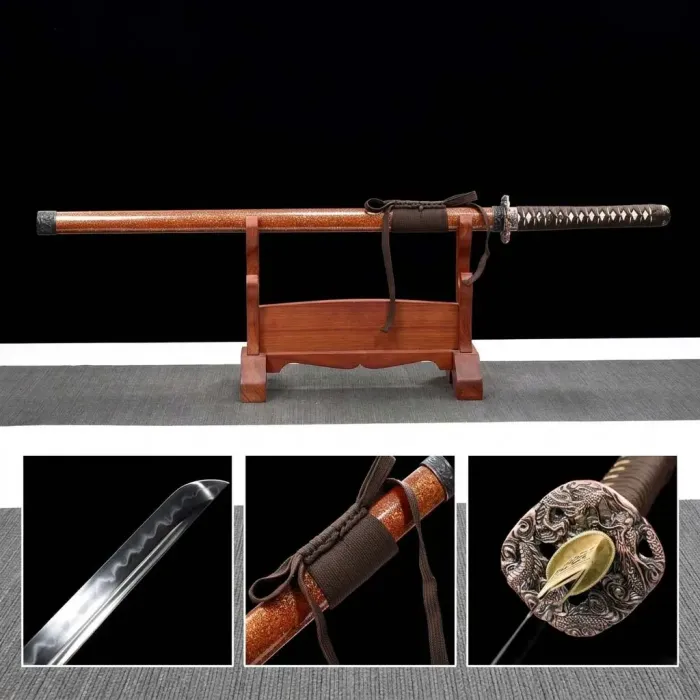
This conventional oriental sword serves as a impressive display of technique, but how about you seek to show your own style? Personalizing your gear is a profound journey, allowing you to assemble a truly exceptional piece. From the grasp wrapping and fitting to the barrier design and temper line, each part offers a chance for custom touch. This inquiry delves into the realm of katana enhancements, providing perspectives for both apprentices and accomplished enthusiasts hoping to create their trace on the classical art of the samurai.
Novice's Verified Handiwork
For people ready to embark on the advantageous journey of classical sword techniques , 1060 steel katanas extend an excellent entry point. This certain grade of elemental steel finds a suitable blend between affordability and functionality . While inferior to hard as elite steels, 1060 provides a adequate level of edge development , making it perfect for learners to develop the rudiments of cutting tool servicing and understand the refinement of expertly made Japanese weaponry. It’s a outstanding choice for cultivating experience without the financial burden of more advanced steels.
T10 Steel Katanas : Balancing Performance and Affordability
For enthusiasts seeking an authentic cutting instrument experience without crossing the financial plan, T10 fabrication katanas represent a inviting option. These instruments offer a substantial improvement in strength compared to inferior alternatives, exhibiting sufficient edge retention and ample flexibility for simple chopping techniques. While not rivaling the superior characteristics of higher-grade steels like T100 or folded substance , T10 provides a impressive blend of capacity and profitability, making them a favored choice for beginners and those on a limited resources .
Moving beyond the Cutting Surface : Tailoring Your Sword's Fittings and Grasp
Whereas the sharpened blade is undeniably the important point of a katana, truly improving its presence lies in the careful customization of its details and hilt . This practice allows owners to communicate their personal approach . Contemplate the expansive possibilities: menuki - decorative embellishments that add visual charm ; the hamon encasements – often delicately carved ; the tsuka core itself, wrapped in customary ito braid ; and the fusa terminal , which can be made from various ingredients like alloys or shell .
- Opt for ideas that harmonize with you.
- Delve into with assorted mediums.
- Highlight merit for a permanent result .
The Allure of the Katana: History, Craftsmanship, and Steel
Every nihonto exhibits a unique allure, steeped in generations of Far Eastern history and custom . More than merely a instrument of hostilities , it's a symbol of the fighter ethos – a fusion of ability and discipline . Its progression spanned various generations, with early cutting tools evolving into the elegant curvature and fatal edge we distinguish today. The construction involved is truly extraordinary , requiring lifetimes of education to achieve . The process involves a complex folding of steel bloom , creating layers that boost the steel’s flexibility and cutting ability. Various schools of blacksmithing started , each with their distinctive secrets and practices for achieving the flawless balance and keenness - a truly demanding pursuit.
- Primary Katana varieties
- The responsibility of the historical weapon in soldier culture
- Established processing methods
Selecting the Ideal Steel for Your Japanese Sword Project: 1060 vs. T10
Deciding on the suitable steel is remarkably important for any blade project, and the selection between 1060 and T10 can be challenging. 1060 is a widely used American metal, offering a tanto decent balance of hardness and toughness, making it appropriately easy to condition. However, T10, a Far Eastern steel, habitually boasts heightened wear sustainability and can conceivably achieve a more ultimate hardness, although it can be more difficult to apply and requires detailed heat forging. Consider your background and anticipated benefits: for a rookie, 1060 may be a simpler starting point, while the master smith might admire the augmented attributes of T10.
- Simplicity of Utilizing
- Resistance
- Definitive Durability
Opening the Possibilities: Elite Katana Enhancement Procedures
Honing the expertise in edge enhancement extends far beyond basic stropping. Serious masters are now investigating advanced techniques to truly expose a blade's hidden potential. This comprises intricate work with the temper pattern, utilizing specialized compositions for differential strengthening and carefully choosing the outline of the protector to optimize balance and performance. Beyond purely functional customizations, artisans are increasingly focused on producing unparalleled aesthetic magnificence, through complex incising and layered finishes that truly transform a katana into a magnum opus.
From Ordinary Steel to Fine Blade: Fabricating a 1060 Katana
The journey commences with plain 1060 iron , a solid material far distant the fine katana it will evolve . Accomplished bladesmiths utilize a sophisticated process of layering and hammering the raw steel, repeatedly firing it and flattening it to extract impurities and establish a uniform grain structure. This exhausting process, often going on for months , builds the imperative strength and elasticity characteristic of a original Japanese sword . Continued heat manipulations , including accurate hardening and cooling , are mandatory to achieve the desired harmony of sharpness, persistence and magnificence.- Layering: Minimizes impurities and constructs grain structure.
- Constructing: Forms the steel into the initial blade form.
- Quenching: Controls the final hardness and flexibility.
The Ongoing Allure of the Katana: Detailed Survey of Metal and Enhancement
Each traditional katana stays a captivating symbol embodying Japanese custom , its enticement far beating mere weaponry . Forged from a special steel and sometimes featuring intricate motifs , the practice of creation itself is a esteemed art. Beyond the crucial craftsmanship, the ability to alter a katana - from the temperation to the hold wrapping and fastening - facilitates for a wholeheartedly individual exhibition for both curators and practitioners alike. This combination of historical steelwork and boundless personalization contributes the katana's continued popularity across the globe .
